
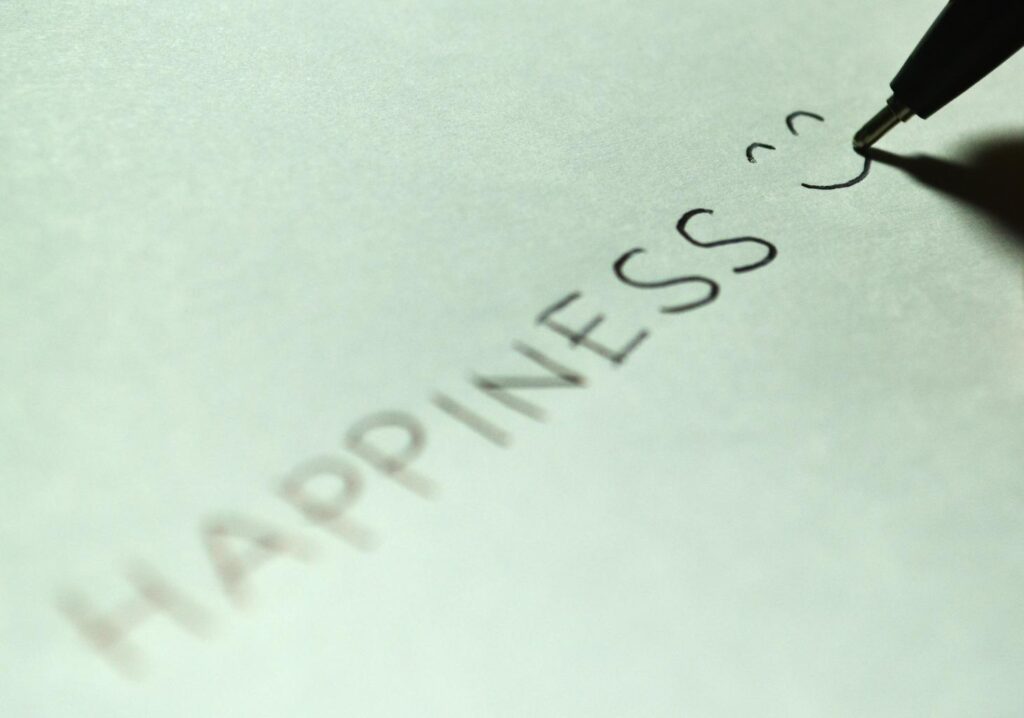
The question of happiness had been on my mind ever since I decided to scrap my usual list of New Year’s resolutions—those well-meaning but often empty promises to go to the gym more, or learn whatever random skill was occupying my thoughts at the time (last year, it was learning German; the year before, guitar). This year, I settled on a single goal: to be 10% happier. The numerical percentage comforted me; it felt manageable, a modest increase. If I didn’t succeed, I could blame the formula. After all, ten percent of nothing is still zero.
This resolution led me to sign up for PSYC34: The Psychology of Happiness and Meaning. I went into it with perhaps too-high expectations; the course was taught by one of my favourite professors, and I’d simply decided that this guy knew what he was talking about; after all, they didn’t hand out PhDs to just anyone. Our first assignment was to fill out a survey about our general thoughts on happiness. When asked whether I thought happiness was achievable and what it truly was, I responded with my usual pessimistic views, which I insisted were just realistic: “I don’t believe happiness, the way we talk about it, is real. Constantly striving for our idea of a happy life is exhausting and aimless. If happiness is simply a result of a well-balanced cocktail of dopamine, oxytocin and endorphins, then there’s no use journeying toward our imagined ‘happier’ destination, as it doesn’t exist. We should instead strive to be simply content.” At the time, I essentially saw happiness as just another emotion—momentary, fleeting. I believed it was entirely situational and largely dependent on external factors. Anyone who preached that happiness was a choice, I thought, was either wrong or lying.
Happiness appeared to be an optical illusion, a one-dimensional checkered tunnel, seeming to stretch on forever. I was convinced it was a cruel, man-made trick, a mythological utopia, one that was constantly getting further and further from reach. It was simply impossible for most people to attain.
Going into my experiment, I theorized that if happiness is simply a feeling, then doing things that elicited that emotion would naturally result in more happiness. And since my idea of a good time consisted of listening to morbid music while reading tragedies, I was certainly not an authority on what could make me happy. My hypothesis, then, was that by doing what made others happy, I’d become happier myself.
Copious amounts of research into various forms of literature only prompted more questions. A meta-analysis published in Nature Human Behaviour reviewed data from numerous scientific studies investigating the impact of various well-being interventions. It found that the most effective strategies were those centred on mindfulness, designed to increase our “positive resources.” Practising gratitude exercises and savouring the present moment consistently showed promising results. Inspired, I started a gratitude journal on my notes app, aiming to write down one thing I was grateful for each day. This simple habit made me far more present. I began spending quiet moments—walking home or standing in line to order lunch—actively searching for things to appreciate.
In my exploration, I found that happiness research often divides itself into two schools of thought: hedonic and eudaimonic. Hedonic happiness focuses on maximizing pleasure and minimizing pain, while eudaimonic happiness centres on the fulfilment that comes from purpose and meaning. The Greek word eudaimonia translates to “the condition of good spirit”—essentially, happiness. Aristotle philosophized it to be “the meaning and purpose of life, the whole aim and end of human existence” in Nicomachean Ethics. This quote stuck with me as I tried to reconcile the more self-indulgent aspects of happiness with deeper, value-driven pursuits.
My hedonic pleasures were easy to identify: good food—like mint chocolate chip ice cream—or watching a favourite movie. But when I tried to explore what eudaimonic happiness meant for me, I quickly drew a blank. I could easily claim to value certain virtues like kindness, truthfulness, or responsibility, but was I actively practicing them? Did they actually bring me joy in my day-to-day life? After an hour-long call with my siblings, my sister, ever the practical voice, pointed out that I was thinking too broadly. She suggested condensing it down to a simple idea: just try to be a good person. When even that felt overwhelming, she told me to do one good thing for someone else.
Generosity seemed to bridge these two ideas, creating an immediate reward or “warm glow” effect, as well as enhancing our sense of meaning. The next day, I felt encouraged to buy lunch for a young man sitting by the subway station entrance, wrapped in a too-light coat, ignored by most passing by. When I handed him the bright red canvas bag filled with baked goods, drinks, and a warm meal from the Metro across the street, his brown eyes lit up with a grin that made him look surprisingly young—he couldn’t have been much older than me. His quiet gratitude stayed with me. Our interaction was a ripple spreading through the often-neglected web that binds us all together through sheer proximity. Eudaimonia, in its simplest form, spreads from our shared humanity: a simple act of care for another person or an infectious smile from a kid on the subway.
I was curious to hear opinions about happiness directly from people around me. So, I created a simple questionnaire with general questions like, “What do you do to be happier?” and more vaguely probing ones such as, “How happy would you say you are?” My goal was to curate a list of random people’s “happiness activities” to immerse myself in. My interviewees were a mix of unsuspecting strangers who happened to be in the same place and time as me, and those already in my life who couldn’t escape my unending philosophical questioning about their happiness. I interviewed people on the bus, older ladies I met browsing bookstores, and even the guy walking his dog in the same direction as my route home. I’d forgotten his name the moment he told me, and had taken to calling him the “Golden Retriever Guy” (GRG) in my head—not for the reasons you might think.
Golden Retriever Guy shared that he was happiest on walks with his dog, Butch, a friendly, purebred German Shepherd. I was invited to tag along for the rest of their walk circling the neighbourhood. Butch, who was under a year old and absolutely adorable, was ecstatic to show off all the tricks he’d learned. He explored every inch of the trail as if he were discovering it for the first time, sniffing at every pile of crumpled orange and brown leaves and often needing to be gently stopped from trampling over people’s flower beds and succulents. Every once in a while, Butch would trot up to me, eagerly seeking attention, which I was more than happy to give. I’d run my fingers through his thick golden–black coat and exchange serious, businesslike handshakes with him whenever he looked at me as if asking for confirmation of his ‘good boy’ status. His enthusiasm was contagious, and I repeatedly found myself laughing at his antics.
Golden Retriever Guy told me he had recently moved out of his parents’ house and hadn’t visited since. His mother and stepfather, expecting their second child, were too busy for him. His stepfather, who had helped raise him since he was around ten, was growing tired of GRG. They’d decided he wasn’t the best influence and was to move out after his senior year. Instead, he left that same week.
“There just wasn’t a place for me there, y’know?” he said, petting Butch with a bittersweet smile. A cold rage filled my chest on his behalf—he’d been essentially rejected by his own family, forced to leave his childhood home. Even now, he didn’t feel welcome to visit. Yet, he didn’t seem angry talking about it, just quietly forgiving the injustice. The only way for him to feel better was by avoiding the tense situation back home. He was focusing on his own life instead. Butch was a great comfort to him after each awkward call home. “I can’t change them, but I can accept that and move on,” he said with a little head tilt, oddly reminiscent of his dog.
This idea of acceptance intrigued me. I considered myself a staunch advocate for change, so I’d never understood how people could let go of things easily. In middle school, I’d even kept a journal made up entirely of detailed entries about who had wronged me and how. GRG’s forgiveness of his parents stayed with me. How was he able to grapple with his anger, and eventually abandon it? I would’ve nursed my rage like a newborn.
When I eventually got home, I caught my reflection in the entryway mirror and was surprised to see a large smile pasted under my bright red nose. I had to admit GRG was right. Butch was a living embodiment of joy itself. I couldn’t imagine feeling sad after spending time with him. It seemed obvious, though, now that I’d thought about it. Holding onto grudges was detrimental to your wellbeing, and therefore happiness. But, why? At this point, I knew who to ask.
My mother was the most forgiving person I knew, a fact that had irritated me to no end growing up. She was the kind of person who’d already forgiven you before you’d even made the mistake. She’d always championed the importance of forgiveness—not for the sake of the person who hurt you, but for yourself. What if she was right? What if clutching desperately onto grudges was constantly regurgitating the experience and embedding the negative feelings attached to it? Was the secret to happiness simply to forgive and forget?
Apparently, I’d caught my mother at an uncharacteristically melancholic moment. She admitted, “Sometimes I wish I remembered things better so I could simmer in those resentments, but that doesn’t help me,” she continued. “Letting go brings me peace.” Neuroimaging studies on memory, like those conducted by Elizabeth Phelps at Harvard University and Joseph LeDoux at New York University, suggest that our minds can’t fully grasp the difference between recalling a memory and a current event. The phrase ‘time heals all wounds’ only rings true if you aren’t constantly reopening them. Recalling happy memories lights up all the same areas in your brain as during the original experience, meaning your body digests those feelings all over again. The same is true for traumatic memories, as well as the pettier ones, like the time a girl borrowed my favourite sparkly purple pen and never returned it in second grade.
Khadija, a UTSC student I met at the bus stop outside campus, spent the whole ride sharing her perspective on happiness. She told me that it comes in many forms, from the big, life-changing miracles—like her surgery going well last year—to the small, everyday things we might miss if we’re not paying attention. “Like if there’s a sale on your favourite food at the store,” she said, gesturing vaguely south, “or a cool bug you see on a walk.”
The bus hit a pothole and caused her to jolt. I watched as she reached up to check her hijab was still positioned correctly, and thought about what she’d said. Her outlook was refreshing. She was genuine about how focusing on these unexpected little things brought her small bursts of joy she treasured as much as the bigger events. It made me wonder: how many of these tiny glimpses of joy do we let slip by unnoticed? Are we essentially missing out on our own happiness?
Khadija’s words inspired me to start a new page on my notes app titled “Tiny Happy Things,” and for the next few weeks, I diligently documented anything that sparked a bit of joy. I imagined myself hoarding those delicate moments, creating a collection of bliss, like a magpie gathering shiny objects for its nest.
By the end of the month, I reviewed my notes and found myself smiling at random entries like “my coffee tasted good today” and a cryptic one that read “sunny day + Cindy Lauper = dopamine hit,” which I couldn’t quite remember the significance of, but somehow still made me smile.
A personal talk with Dr. Ravi Thiruchselvam, my PSYC34 instructor, gave me what I needed to finally abandon my cynical views on the subject. He believed that sources of fulfilment were already embedded in our lives. Happiness was essentially internal; it already existed, we just needed to access it. His solution? Liberation from the shackles of our desires—the assumption that our satisfaction could only result from the gratification of getting what we want.
“There is no happiness formula,” he said. Our overall life satisfaction, he explained, is shaped by how we process and remember events. “How you judge your experience as a whole is weakly correlated to how you actually felt.” So, by being more present and aware of our emotions, moment to moment, we can balance our internal biases when evaluating our lives. This exercise shifts our focus to our current mood, helping us better appreciate what we have instead of focusing on what we lack.
One friend told me that whenever she felt down, she’d plan a date with her boyfriend. Since I didn’t currently have a partner and wasn’t about to tag along on hers, I decided to take myself on a date instead. In typical fashion, I ended up getting lost for hours downtown. And though I never did make it to the aesthetically pleasing and overpriced coffee shop she’d recommended, I spent a peaceful afternoon on Queen Street West. A mango ice cream cone proved to be a suitable consolation prize. Ending up with a cold for the entirety of reading week, however, was the only unfortunate result from my escapades.
My conversations consistently brought up similar topics. Everyone agreed that spending time with family, being in nature, going on adventures, and indulging in creative pursuits brought them happiness. While I tried to incorporate all these activities, it turned out to be more difficult than expected, mainly due to my tendency to abandon any artistic project and alleged allergy to the outdoors. Nature may work for some people, but the most helpful advice I found in The Happiness Project by Gretchen Ruben; was to ‘just be Gretchen’—or, well, just be me.”
Throughout my happiness experiment, I discovered that while happiness can feel elusive, it’s something we can actively cultivate. One key realization was how much easier it is to be sad than to be happy. Happiness isn’t a choice we can simply switch on, but we can choose to take actions that nurture it. I noticed that we often make efforts in many areas of life—going to the gym to improve our health, setting academic or career goals, and even working on our personality or attitude. Yet, we rarely dedicate the same level of intention and effort to cultivating happiness.
We tend to ask ourselves; “What could make me happier?”—a question that usually leads to dwelling on what we lack. Thoughts like, “I’d be happier if I were richer, if I lived somewhere warm, if I didn’t have chronic pain,” often come to mind. For me, this question often spirals into a deeper sense of frustration, as it taps into the parts of my life that feel out of my control. I spend a lot of time in my own head, mentally retracing mistakes and rehashing past events. It’s a cycle of mental time travel that keeps me stuck in a place of longing for something more, something better. I’ve realized that this focus on what’s missing has made it harder for me to access happiness in the present. Happiness feels more elusive when I’m constantly stuck in the past or in what could be.
Instead, I found that the better question to ask is, “What can I do right now to bring a little more joy into my life?” This shift in focus from things I couldn’t change to things within my control was surprisingly powerful. By focusing on small actions, like going on walks, noticing the “Tiny Happy Things” I find throughout my day, or even the occasional frozen treat, I was able to actively bring more happiness into my life.
Trying to engage in activities that other people had shared with me, I’d subconsciously caused a shift in my perspective. By trying on others’ happiness habits for size, I was attempting to put myself in their shoes. This helped reframe my entire concept of happiness. The goal wasn’t to pretend that everything was perfect, but to actively work to make life a little brighter each day. Life is too short to sit back and wait for happiness to fall into your lap. Happiness is something we need to get proactive about. Turns out, it’s not found in some grand adventure like skydiving, but in the mundane moments of daily life.
Aristotle. Nicomachean Ethics. Translated by Terence Irwin, 2nd ed., Hackett Publishing Company, 1999.
Phelps, Elizabeth A., and Joseph E. LeDoux. “Contributions of the Amygdala to Emotion Processing: From Animal Models to Human Behavior.” Neuron, vol. 48, no. 2, 2005, pp. 175–187.
Rubin, Gretchen. The Happiness Project: Why I Spent a Year Trying to Sing in the Morning, Clean My Closets, Fight Right, Read Aristotle and Generally Have More Fun. HarperCollins Canada, 2009.
van Agteren, J., et al. “A Systematic Review and Meta-analysis of Psychological Interventions to Improve Mental Wellbeing.” Nature Human Behaviour, vol. 5, no. 5, 2021, pp. 631–652. https://doi.org/10.1038/s41562-021-01093-w
GANNA ELGABBAS is a psychology and creative writing student at UTSC. She is passionate about understanding the human mind and telling emotionally resonant stories. Blending research and creativity, she explores themes of identity, resilience, and connection. Her work reflects curiosity about what shapes human behavior and a deep interest in empathy and meaning.